District Superintendent Scott Budelmann testifies on behalf of the BOCES of NYS
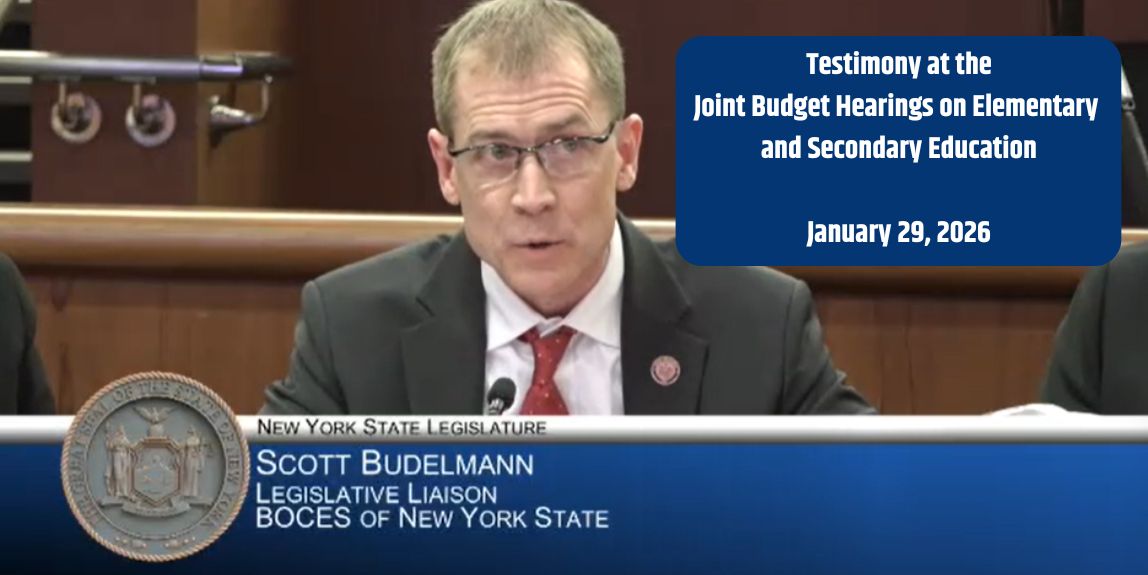
Scott Budelmann testified at the Joint Budget Hearings on Elementary and Secondary Education on Thursday, Jan. 29, 2026. The transcript of his testimony is below.
Good morning, Chairpersons Krueger, Pretlow, Mayer, and Benedetto, and other Members of the Senate and Assembly. I am here today on behalf of BOCES of New York State, the entity representing the District Superintendents of the 37 Boards of Cooperative Educational Services(BOCES) of New York State. Thank you for allowing us the opportunity to provide some important information about the current state of New York’s education system as well as how the proposed State Fiscal Year 2026 Executive Budget Proposal would impact the State’s 37 BOCES, and the nearly 700 school districts and their students that the BOCES of New York State serve.
BOCES were created by the Legislature in 1948 “for the purpose of carrying out a program of shared educational services in the schools for the supervisory district and for providing instruction in such special subjects as the commissioner may approve.” There are 37 BOCES located throughout the State. With the exception of the Big Five, all but 4 public school districts are component school districts of a BOCES. It is important to note, however, that BOCES collaborate with many of the Big 5 districts to serve students. Over 100,000 students participate in BOCES’ programs on a daily basis throughout the State. One of BOCES’ missions is to prepare a diverse student population for roles in the global economy and provide services and initiate collaborations designed to close the gaps in student achievement.
BOCES is the premier example of inter-municipal collaboration in New York State. For more than 75 years, school districts have been able to use BOCES to provide a wide range of educational programs and other services through an organizational structure that is a model of cooperation. In addition, BOCES are able to efficiently provide services that not every district can provide effectively. These include but are not limited to:
-
- Enrichment programs.
- Special education programs.
- Career and Technical Education programs.
- Behavioral health services.
- Technology services (through the Regional Information Centers).
- Professional Development.
- Central business offices.
School Aid
BOCES do not receive Foundation Aid or direct formula aid from the State. BOCES rely almost entirely on their component school districts for funding. As a result, the financial stability and health of these districts — and therefore the distribution of Foundation Aid and other aids—are critical to BOCES operations.
BOCES exist to support districts and their communities, adapting services as demographics and needs change. While current funding mechanisms allow for growth in BOCES programs that educate an increasing number of students in special education, Career and Technical Education (CTE) and English as a New Language, many emerging community needs require services that existing funding mechanisms currently do not support. It is essential that all funding formulas reflect current data and realities. Moreover, it is critical that the State support districts seeking innovative ways to share and consolidate services, even in the absence of a full reorganization. Full reorganization, most commonly thought of as mergers, require voter approval.
The Executive Budget proposal would provide approximately $38.3 billion in traditional School Aid as reflected on the runs, an estimated year-to-year funding increase of $1.3 billion or 3.6%. Of that $1.3 billion increase, $779 million is increased Foundation Aid for a total of $27.1 billion. This proposal would provide a 1% minimum increase to all districts and fully fund expense-based aids.
The proposal also includes language that would permanently freeze school aid to the database used to generate school aid runs for the Executive Budget proposal. The State’s funding formulas can only work effectively with up-to-date data and should be allowed to utilize that which is available.
Recommendations:
-
- Provide at least the level of funding proposed by the Executive.
- Increase funding targeted at supporting high-need students including students with disabilities, English language learners, and homeless youth.
- Update the Regional Cost Index statewide.
- Consider changes to the expected local minimum contribution to reflect the implications of the tax cap.
- Establish new tiers within the Reorganization Aid formula to allow districts that substantially consolidate or share programs and services to access a commensurate portion of these funds to support the start-up costs associated with the transition of these programs.
- Reject the Executive proposal to freeze school aid payment to the database used to generate the school aid runs associated with the Executive Budget proposal.
Workforce
BOCES, like school districts and other employers, are facing critical workforce shortages. Statewide, there are shortages in candidates to fill key staff positions such as teachers, mental health professionals, and bus drivers. In instances where those positions have been filled, too many individuals are choosing to leave for other employment opportunities. There is no single solution to this problem. Steps must be taken to both attract people to enter these professions and to create incentives for them to remain. Costs associated with higher education for teachers, administrators, and mental health professionals can be a deterrent to young people in deciding to enter these fields. Meanwhile, a lack of staff can jeopardize the ability of schools to provide programs for students.
To address these issues, we encourage the State to take steps, not only to bring people into these professions, but to help encourage them to stay in these roles. These incentives could include offering scholarships and loan forgiveness.
We were pleased to see that the Governor included some incentives to help further with recruitment and retention, including: $2 million to support new grants for Pathways in Teaching Early College High School Programs. We also applaud continued investment in the following programs.
-
- $400,000 for Empire State Excellence in Teaching Awards.
- $22.5 million for the Master Teacher Program.
- $1.4 million for Teacher Mentor Intern Programs.
- $1.882 million for Accelerated Teacher Preparation Pathway Programs.
- $1.75 million for Teachers of Tomorrow.
But more help is needed.
Another barrier to recruiting and retaining employees is the complicated and outdated civil service system. While we recognize that eliminating competitive exams entirely may not be constitutionally permissible, the innovative steps taken to minimize reliance on them through programs like New York HELPS and other opportunities that rely on resume and experience review are helping to build the pipeline and address problems caused by tests that do not accurately reflect the knowledge and skills associated with the job title or reflect cultural bias. We tell our students throughout their academic careers that achievements are more than a single test score—the same should be true in professional careers.
Recommendations:
-
- Continue to establish and expand scholarship and loan forgiveness programs for teachers, other educators, and mental health professionals who commit to remaining in New York.
-
- These could be modeled after the successful Nurses Across New York and Nurses for Our Future programs.
-
- Increase investments in Teach NY, Teacher Apprenticeships, the Teacher Ambassador program, and the Master Teacher program.
- Continue to modernize civil service hiring and promotion rules to reduce reliance on tests and canvass lists.
- Continue to establish and expand scholarship and loan forgiveness programs for teachers, other educators, and mental health professionals who commit to remaining in New York.
FAPE 22
Until recently, special education students’ entitlement to a Free Appropriate Public Education (FAPE) was interpreted to extend until they graduated or turned 21. New York State law expands on that, allowing students who have not graduated to remain in school, and for the districts to receive aid, until the end of the school year in which they turn 21. However, recent court rulings have reinterpreted this entitlement to mean until age 22 rather than until age 21. Unfortunately, these rulings do not authorize the payment of State aid for students after the end of the school year in which they turn 21, leaving local school districts solely responsible for the cost to educate these students. If the State requires districts to educate students until age 22, it should also fund their education accordingly.
Recommendations:
-
- Amend current law to provide school aid for special education students until they graduate or until the end of the school year in which they turn 22.
Zero-Emission Bus Transition
The transition to zero-emission school buses represents a major shift to the delivery of pupil transportation in New York. Districts around the State will need significant administrative and financial support to approach this work. BOCES stand ready to support their component districts approach this work and want to identify barriers and challenges that have already emerged and
that the State could help address.
Recommendations:
-
- Adopt a process to address purchases in cases of failed bond votes and budget votes for purchasing zero emission buses.
- Assign financial and logistical responsibilities for non-district infrastructure upgrades.
- Establish funding streams to aid payments for charging “out-of-district” buses.
Public Sector BOCES Leases
To deliver high-quality education, students need appropriate learning environments. Unlike traditional school districts, BOCES often lease space rather than own property because they are not taxing entities and rely on their component districts for capital project funding. As a result, BOCES may not own property as fiscally independent districts do.
With increasing demand for BOCES programs, particularly in Career and Technical Education (CTE) and special education, the need for additional space is growing. Current law allows BOCES to lease buildings and property from private sector entities for up to 20 years, with an option to extend by 10 years with the approval from the Commissioner of Education. However, leases with public entities, including school districts, are limited to 10 years.
In some areas of the State, privately owned space is both available and cost effective, but in others, it is prohibitively expensive. Additionally, leased spaces, including schools, often require substantial modifications to meet the needs of BOCES programs. Extending lease terms would encourage owners to support necessary improvements by securing longer-term tenants, while also providing BOCES and districts more flexibility in financing these projects.
Recommendation:
-
- Extend allowable lease terms between BOCES and public sector entities to 20 years, aligning them with private sector lease terms.
On behalf of BOCES of New York State, I thank you for the opportunity to share our reaction to the Executive Budget proposal and your efforts to build on the proposal to serve all of New York’s students. Thank you for considering the perspective of BOCES of New York State as a part of the conversation. I am happy to take any questions at this time.